

Executive summary
Manual CRM data entry produces delayed, incomplete, and biased data.
Forecast models trained on human-entered data amplify optimism instead of exposing risk.
Most forecast misses are caused by missing activity signals, not bad math.
Autonomous CRM captures revenue data automatically from real work (email, calendar, meetings).
This shift replaces compliance (“update your CRM”) with execution (the system updates itself).
Clean, real-time data is the prerequisite for decision intelligence and probabilistic forecasting.
Introduction
Sales forecasts don’t fail because teams lack dashboards or AI models.
They fail because the underlying data is wrong, late, or incomplete.
For decades, revenue systems have depended on sales reps to manually record reality after the fact. That assumption no longer holds. Manual data entry creates structural blind spots: activity that happens but never reaches the CRM, risk signals that appear too late, and forecasts built on optimism rather than evidence.
As revenue complexity increases—more stakeholders, longer cycles, external dependencies—the cost of delayed data compounds. By the time leadership reviews the pipeline, the situation has already changed.
Autonomous CRM emerges as a response to this failure. Instead of asking humans to document work, it observes work directly and updates the system of record in real time. This shift is not about productivity or convenience. It is about restoring forecast integrity.
What follows explains why manual CRM input breaks forecasting, why analytics alone can’t fix it, and why autonomy is now a structural requirement for reliable revenue intelligence.
The hidden cost of manual CRM data entry
Manual CRM entry doesn’t just slow teams down. It distorts reality.
Sales reps are hired to advance deals, not to document them. Data entry is therefore postponed, approximated, or skipped. The result is structural data latency: key interactions happen, but the CRM reflects them days later—or never.
A meeting with new stakeholders happens on Tuesday.
The stage change or notes appear Friday afternoon, if at all.
During that gap, leadership reviews a pipeline that no longer exists.
This delay is not neutral. Forecasts built during the week rely on stale signals:
email threads going cold,
meetings repeatedly rescheduled,
decision-makers quietly dropping out of the process.
Those signals live in inboxes and calendars, not in the CRM. As long as humans are responsible for surfacing risk, the system only sees what reps choose to report. Optimism is overrepresented. Bad news arrives late.
This is how “end-of-quarter surprises” happen. Deals don’t collapse overnight. They decay gradually, invisibly, while the CRM continues to show confidence. Manual entry doesn’t reveal risk late—it hides it until intervention is no longer possible.
At scale, this isn’t a discipline problem. It’s an architectural one.
Why “better forecasting” fails without better data
When forecast accuracy drops, the usual response is to add sophistication on top: new dashboards, richer scoring models, more “AI” layered onto the CRM. The assumption is simple—if the analysis is smart enough, precision will follow.
It doesn’t.
Forecasting models can only work with what they see. If the CRM shows a deal in Negotiation but misses that the buying committee has stopped replying, the model has no signal to correct its confidence. Stage-based probability remains high because the underlying activity data is incomplete.
This is the core misunderstanding. Most forecasting systems analyze reported intent, not observed behavior.
Manual CRM updates reflect what a rep believes, hopes, or wants leadership to see at a given moment. They are sparse by design and biased toward optimism. When AI is trained on that data, it doesn’t eliminate bias—it scales it. The output feels authoritative, but it’s built on partial truth.
That’s why organizations experience “false confidence.” Forecasts look precise, trend lines are smooth, probabilities are neatly expressed—yet misses keep happening. The intelligence layer is functioning correctly. The data foundation is not.
Without objective, continuous capture of real activity, forecasting systems cannot detect early risk. No amount of modeling sophistication can compensate for missing reality. Accuracy doesn’t fail because the math is wrong; it fails because the system is blind.
What an autonomous CRM actually is
An autonomous CRM is not a replacement for Salesforce or HubSpot, and it’s not a new UI layered on top of them. It’s an infrastructure layer that removes humans from the critical path of data creation.
In a traditional CRM, the system waits. Emails are sent, meetings happen, stakeholders change—and none of it exists in the system until a salesperson decides to log it. The CRM is a passive database, dependent on memory, discipline, and incentives.
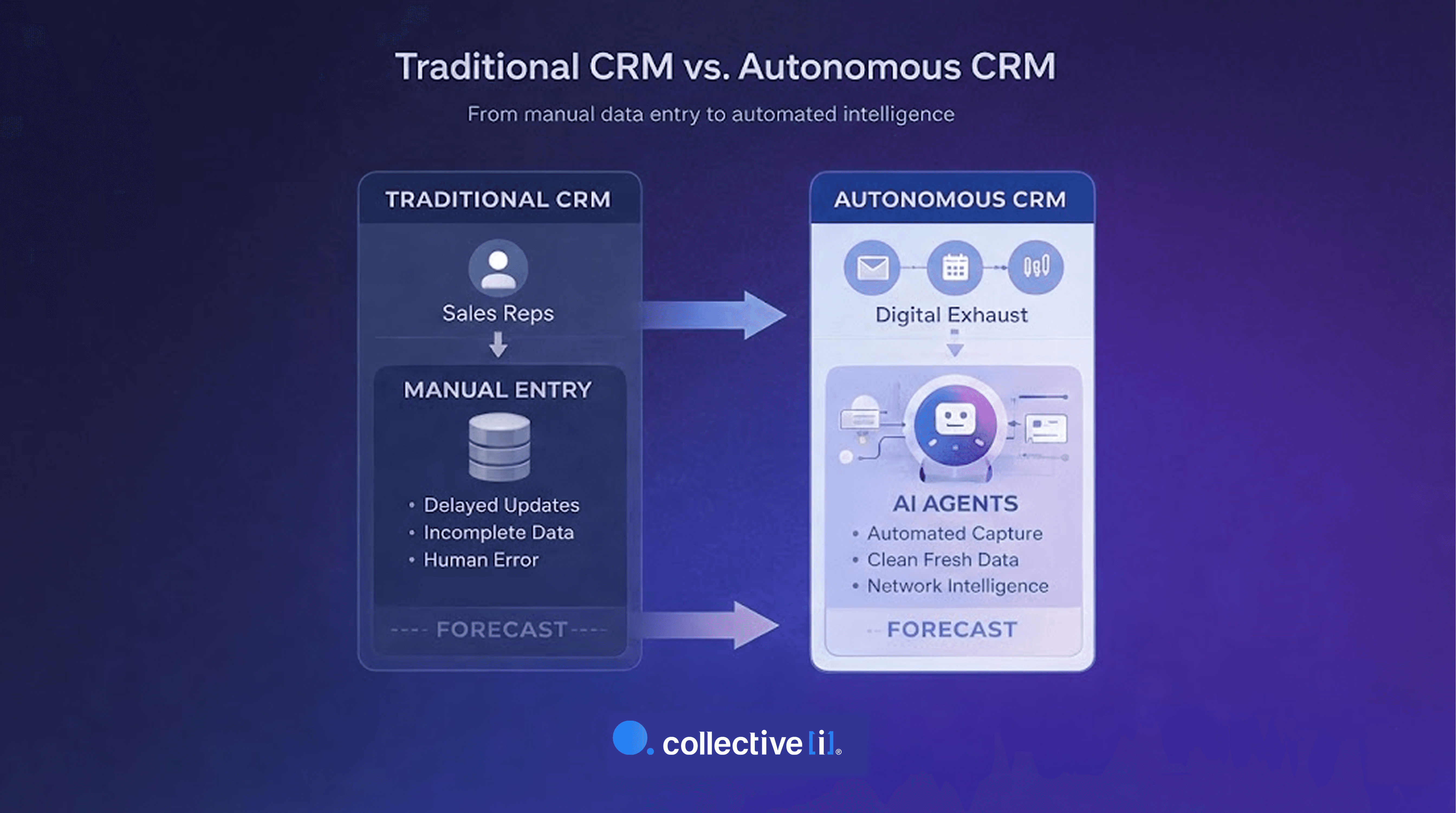
Autonomous CRM captures sales activity directly from emails and meetings, removing manual data entry from forecasting.
Feature | Legacy CRM (Manual) | Autonomous CRM (Agentic) |
|---|---|---|
Data source | Human memory & admin input | Digital exhaust (email, calendar, APIs) |
Update frequency | Weekly / ad-hoc | Real-time / continuous |
Data completeness | Partial | Near-complete |
Bias level | High (optimism & omission) | Low (observed behavior) |
Primary function | Compliance & reporting | Execution & truth |
Forecast foundation | Rep judgment (subjective) | Signal density (probabilistic) |
Risk detection | Lagging | Leading |
An autonomous CRM flips that model.
It connects directly to the company’s operational exhaust: email, calendars, meeting tools, and internal collaboration systems. Software agents continuously observe these streams, identify commercial activity, resolve identities, and write structured data back to the system of record in real time.
No prompts. No reminders. No compliance workflow.
The distinction matters:
Traditional CRM records what users report.
Autonomous CRM records what actually happens.
Because data capture is automatic, coverage becomes consistent. Every meeting, every participant, every follow-up—or lack of one—is logged with the same standard, regardless of who owns the deal. The variability between meticulous reps and overwhelmed reps disappears from the dataset.
The result is a shift from a System of Record to a System of Truth. The CRM no longer reflects intent after the fact. It reflects reality as it unfolds.
From nudges to agents
Most CRM vendors tried to fix data quality with reminders.
Notifications to update fields.
Warnings about missing contacts.
Emails telling reps to “log the meeting.”
This model assumes the problem is discipline. It isn’t.
The problem is incentives. Sales reps are paid to move deals forward, not to maintain databases. Any system that depends on human compliance will degrade as volume and pressure increase.
That’s why nudges plateau.
They increase cognitive load without changing outcomes. Reps dismiss them, postpone them, or batch updates at the end of the week—reintroducing latency and bias into the system.
Autonomous CRM replaces nudging with execution.
Instead of asking a rep to update an opportunity, an agent observes the work directly:
a new stakeholder appears on a calendar invite
a meeting frequency drops
email response time slows
legal or finance joins the thread
The system infers what changed and writes it back automatically.
No reminder.
No approval flow.
No subjective interpretation.
This shift standardizes data at the source. The difference between a meticulous rep and an overwhelmed one disappears from the dataset. What remains is signal, not behavior.
At scale, this is what makes forecasting reliable:
not better dashboards, but the removal of human arbitration from data capture.
Autonomous CRM doesn’t motivate sellers to maintain data.
It removes the need for them to do it at all.
Why autonomous data is the prerequisite for decision intelligence
Decision Intelligence assumes something simple but non-negotiable: the system sees reality as it unfolds.
Not the version reconstructed in a CRM on Friday afternoon.
Not the optimistic narrative of a committed deal.
The actual sequence of signals that precede an outcome.
This is where manual CRM breaks mathematically.
Advanced models—probabilistic forecasting, risk scoring, network intelligence—depend on high-frequency, high-density inputs:
timing between meetings
who is added or removed from the buying group
shifts in response cadence
imbalance between internal and external participation
These signals exist long before a deal slips. But they live in inboxes, calendars, and threads—not in CRM fields.
Autonomous CRM is what makes these signals usable.
By capturing activity at the moment it happens and writing it back in real time, the system creates a continuous, objective dataset. That dataset can then be compared against millions of historical patterns, not just last quarter’s pipeline.
Without autonomy, Decision Intelligence is a theory.
With autonomy, it becomes executable.
This is why forecasting accuracy stalls around 70–80% in most organizations. The limitation isn’t the model—it’s the data generation layer feeding it.
You cannot reason your way out of incomplete observation.
Conclusion
Manual CRM data entry is not a productivity issue.
It is a structural risk.
It introduces latency, bias, and blind spots into the system that leadership relies on to allocate resources and call the quarter. No amount of analytics or AI layered on top can compensate for that.
Autonomous CRM changes the equation by removing humans from data capture and letting software observe work directly. What emerges is not just cleaner data, but a different operating model: one where forecasts reflect reality, not optimism.
As revenue teams move toward Decision Intelligence and network-level forecasting, autonomy becomes the prerequisite—not an optional feature.
The organizations that win in this next cycle won’t be the ones with the most dashboards.
They’ll be the ones whose systems see the truth early enough to act on it.
FAQ
Other resources

Is cold outreach dead? Why network introductions are the future of B2B
Feb 9, 2026
Learning
Is cold outreach dead? Why network introductions are the future of B2B
Autonomous CRM: why manual data entry breaks forecasts
Feb 8, 2026
Learning
Autonomous CRM: why manual data entry breaks forecasts
How modern revenue teams evaluate sales AI in 2026
Feb 7, 2026
Learning
How modern revenue teams evaluate sales AI in 2026
Sales forecasting tools vs analytics platforms vs decision engines
Feb 6, 2026
Learning
Sales forecasting tools vs analytics platforms vs decision engines
What is a revenue operating system?
Feb 6, 2026
Learning