Is fear driving our economy? Why bold leaders are the ones who survive.
•
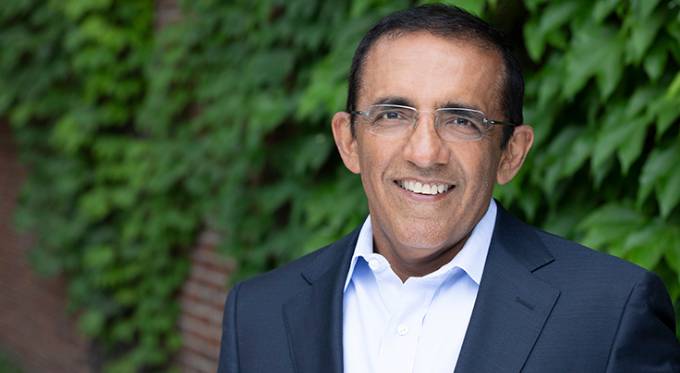
After decades studying why some organizations manage to break through moments of disruption while others stall or quietly decline, Harvard Business School professor Ranjay Gulati has surfaced an uncomfortable but persistent pattern. Fear, when left unexamined, becomes one of the most powerful forces shaping decision-making inside companies.
This insight feels particularly relevant today. AI is rewriting entire industries, economic volatility has become structural, and leaders are expected to make high-impact decisions with incomplete information. In this context, the ability to act boldly is no longer a personal trait or a matter of style. It is increasingly a core organizational capability.
This question was at the heart of a recent C[I] Forecast conversation with Gulati, whose research at Harvard Business School focuses on leadership, purpose-driven growth, and organizational transformation. He is also the author of How to Be Bold, a book that examines courage not as bravado, but as a learnable discipline grounded in research and practice.
Fear is not the problem. Avoidance is.
One of Gulati’s most important distinctions is that fear itself is not inherently harmful. From a neurological perspective, fear plays a protective role. It helps individuals and organizations detect risk and avoid immediate danger.
The issue arises when fear becomes the dominant lens through which decisions are made.
Drawing on behavioral psychology and neuroscience, Gulati explains that under sustained uncertainty, leaders tend to default to behaviors that feel rational but gradually erode momentum. Decisions are postponed in search of perfect data. Ideas are softened or abandoned to avoid reputational risk. Caution becomes synonymous with intelligence.
Research published through Harvard Business Review has repeatedly shown that these patterns rarely register as failure in the short term. Instead, they accumulate quietly, slowing organizations down precisely when speed and clarity matter most.
How fear shows up inside organizations
Fear inside organizations is rarely loud. It does not usually appear as panic or visible indecision.
More often, it shows up as process.
As delay.
As excessive validation.
Gulati has documented how fear subtly hijacks decision-making across leadership teams. CEOs delay necessary pivots because the timing does not feel safe. Teams suppress unconventional ideas to avoid looking uninformed. Organizations reward analytical rigor while quietly penalizing initiative.
Over time, these dynamics create cultures where movement requires consensus, and consensus requires time. Competitors willing to act with imperfect information move faster, while fear-driven organizations wait for certainty that never arrives.
The result is not dramatic collapse, but gradual loss of relevance.
Courage as an organizational discipline
A central argument in Gulati’s work is that courage should not be treated as a personality trait. Boldness is not about being fearless or impulsive. It is about building systems that allow people to act despite fear.
In How to Be Bold, Gulati reframes courage as a discipline that can be practiced and reinforced. Organizations that consistently act boldly tend to share several characteristics.
They understand how fear influences judgment and train leaders to recognize it early. They anchor decisions in a clear sense of purpose, which reduces hesitation when trade-offs become difficult. They normalize vulnerability, allowing leaders to acknowledge uncertainty without undermining trust. And they design decision-making frameworks that support action even when data is incomplete.
These ideas align closely with broader leadership research emerging from Harvard Business School, which increasingly emphasizes courage as a defining capability in environments shaped by continuous disruption.
Acting without certainty
One of the most challenging shifts for modern leaders is accepting that certainty is no longer a prerequisite for action.
Business models now evolve faster than strategic planning cycles. AI-driven change compresses timelines across product development, operations, and go-to-market strategies. Waiting for full clarity often means reacting too late.
Organizations that perform well under these conditions do not eliminate fear. They build mechanisms that prevent fear from becoming the bottleneck. They clarify decision rights, shorten feedback loops, and treat action as a source of learning rather than something to be deferred until risk disappears.
As Gulati argues, restraint is no longer a neutral stance. In many cases, it is the riskiest choice available.
Why this conversation matters now
The C[I] Forecast conversation with Ranjay Gulati was not designed as a motivational talk. It was an exploration of how leaders can recognize fear when it shapes decisions and how organizations can build the capacity to move forward when certainty is unavailable.
Rather than framing courage as an individual virtue, the discussion focused on how cultures, incentives, and systems either suppress or enable bold action. In a world where disruption is constant and nonlinear, this distinction matters.
Fear will always be present. The question is whether it becomes a signal to slow down or a prompt to design better ways of acting.
Watch the conversation and explore what’s next
The full conversation with Ranjay Gulati is available to watch on Intelligence.com, where C[I] Forecast replays and related discussions are accessible through Upskill.
You can also explore Gulati’s research, writing, and speaking on his website, including more detail on his book How to Be Bold.
To discover upcoming C[I] Forecast conversations, visit C[I] Forecast and explore what’s next. Each session is shaped by real questions and real uncertainty, bringing together leaders, researchers, and practitioners navigating complex decisions in real time.